What Is Agentic RAG? How It Works and When It's Worth It
Written By:
RapidFire AI
Published on
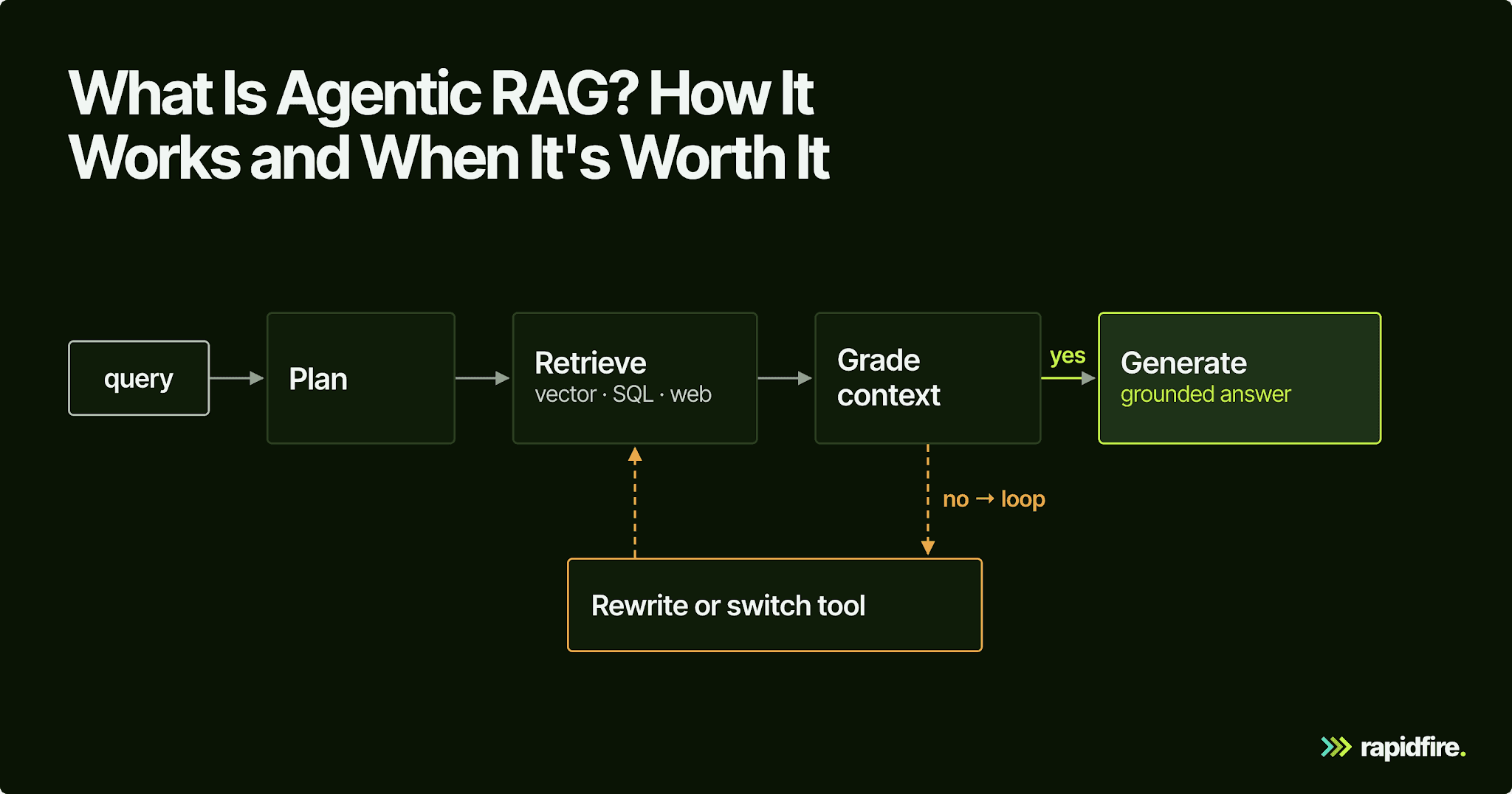
Your RAG prototype handles the easy questions. Then a user asks something that needs an order lookup, a policy document, and a judgment call about which version of that policy is current. A single retrieve-then-generate pass can miss evidence from those sources. Agentic RAG offers another design: put an AI agent in charge of retrieval so the system can plan, search more than once, check what came back, and try again.
This guide covers the retrieval loop, its architectures, and the trade-offs in latency, cost, and evaluation. It also shows how to test the retrieval layer before adding agentic steps.
What Is Agentic RAG?
Agentic RAG is retrieval-augmented generation where an AI agent controls retrieval. Instead of running one fixed search and passing the results to the model, the agent decides whether to retrieve at all, what to search for, and which data sources or tools to use. It also checks whether the retrieved context is good enough before it writes the final answer.
The control layer can plan a sequence of searches, use tools, reflect on results, or coordinate several agents as the task unfolds. In LangGraph's custom RAG agent, the model chooses whether to call the retriever instead of running retrieval on every request.
Take a support assistant that gets "Why did order 4417 ship late, and do we refund the shipping fee?" A standard RAG pipeline embeds that whole sentence and pulls the top-k chunks from one knowledge base, probably the refund policy docs. An agentic RAG system can split the question and query the orders table for 4417. Then it checks the carrier status and only pulls the refund policy that applies to that kind of delay. The large language models doing the reasoning are the same; what changes is who decides the retrieval steps. Think of it as agentic AI pointed at the retrieval problem.
If you want a refresher on standard RAG first, read how a standard RAG pipeline works.
Traditional RAG vs. Agentic RAG
Traditional retrieval-augmented generation is a straight line: embed the query, retrieve once from a vector database, put the chunks in the prompt, generate. A single retrieval call keeps this basic design simple, fast, and relatively inexpensive in tokens. Agentic RAG systems turn that line into a loop, and the loop changes almost every property of the system.
Dimension | Traditional RAG | Agentic RAG |
|---|---|---|
Retrieval passes | One per query | Zero, one, or several, decided at run time |
Who decides what to retrieve | Fixed pipeline code | The agent (an LLM with tools) |
Data sources | Usually one knowledge base | Several: vector search, SQL, web search, APIs |
Error handling | Weak context goes straight to the generator | Can grade the context, then re-query or switch tools |
Latency | One retrieval plus one generation | Grows with every extra model call and tool call |
Token cost | Relatively low | Higher, since each round adds model calls |
How hard it is to evaluate | Score retrieval and the final answer | Also score the path: which tools, how many rounds, when it stopped |
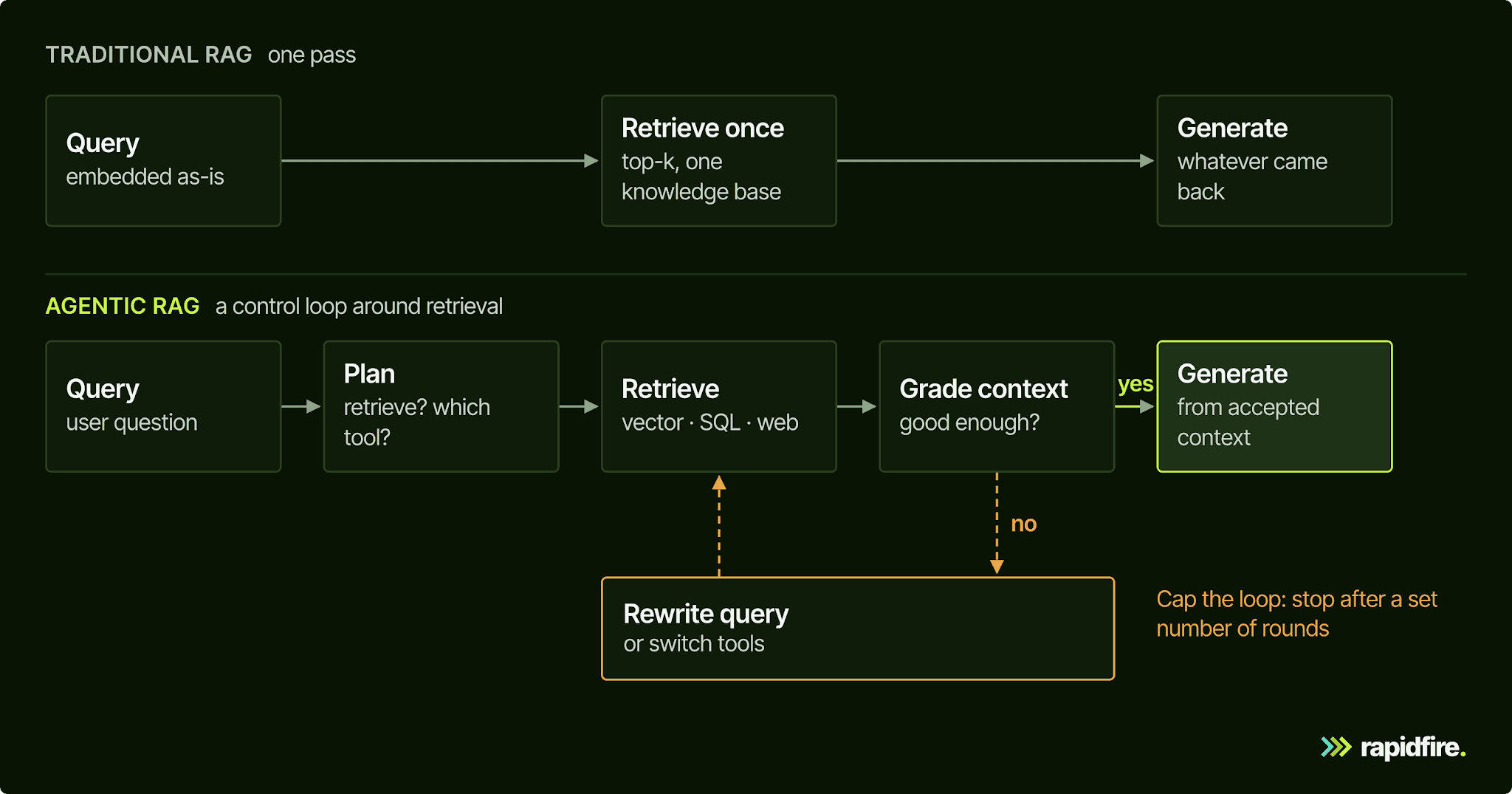
A planning step and grader add model calls; they are useful only if they improve the evidence or answer enough to justify that overhead. Singh et al.'s survey recommends considering simpler modular RAG for well-scoped fact retrieval. Compare both designs on the queries your system will handle.
How Agentic RAG Works
The loop can be divided into planning, routing, context checking, and answer generation.
Planning and Query Rewriting
The AI agent first decides whether it needs to retrieve at all, then turns the user's question into one or more search queries. ChatGPT search is a familiar example. When it uses outside search providers, it typically rewrites your query into one or more targeted queries, and after reviewing the first results, it may send additional, more specific ones. Adaptive-RAG (Jeong et al.) makes the "do I need retrieval?" decision explicit: a smaller language model classifies each query's complexity and routes it to no retrieval, single-step retrieval, or iterative retrieval.
Routing and Tool Use
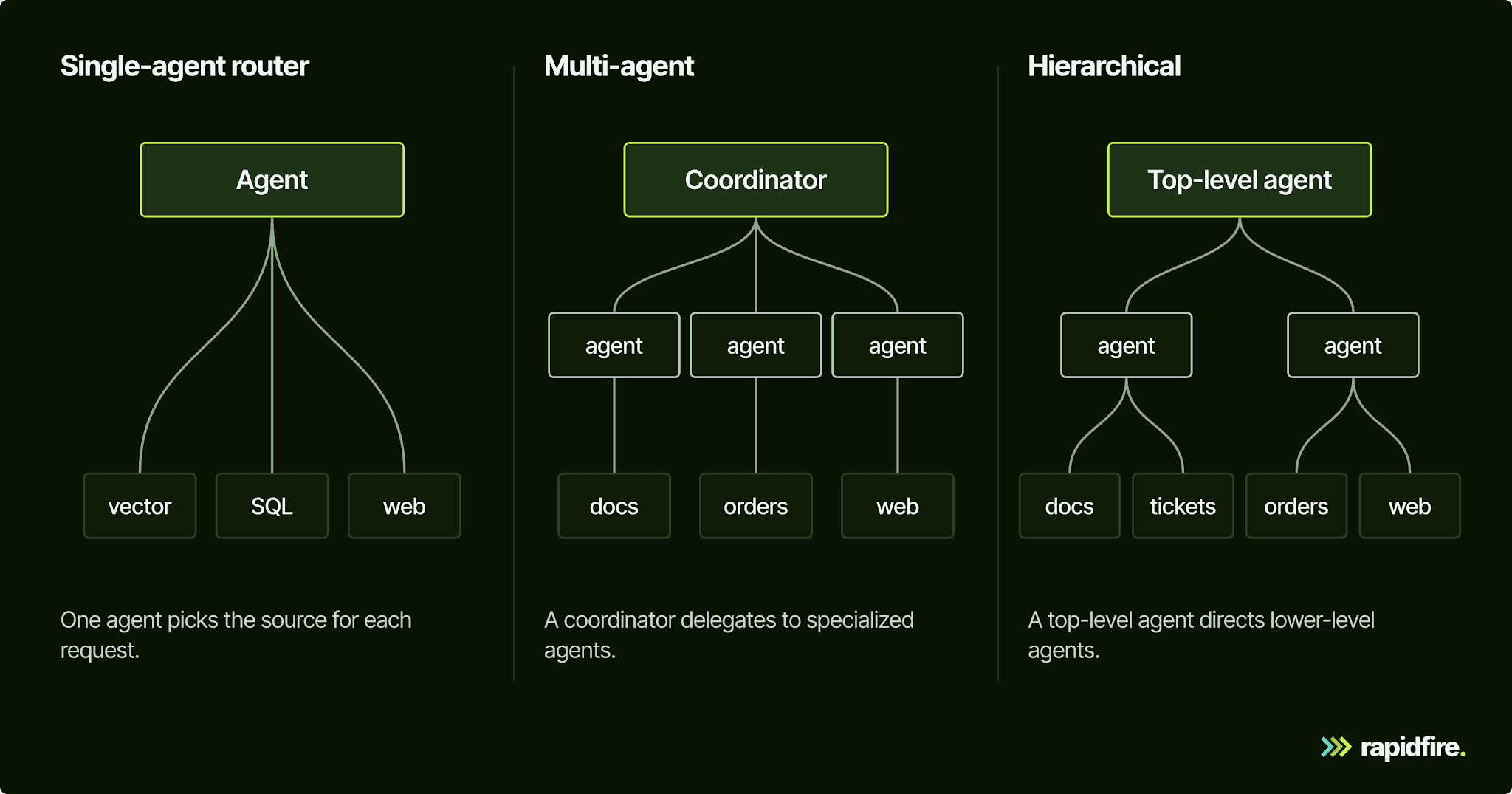
Next, the agent picks a source. A single-agent router uses a coordinating agent to choose among options such as a Text-to-SQL engine for tabular data, vector-based semantic search for unstructured documents, and a web search tool for real-time information. One way to implement this is the ReAct pattern from Yao et al., where the model interleaves reasoning traces with actions so it can query a knowledge base mid-reasoning and update its plan.
Reflection and Self-Correction
After retrieval, the system checks whether the retrieved context actually answers the question. In LangGraph's custom RAG agent, a relevance grader returns "yes" or "no": "no" sends the question through rewriting and another retrieval attempt; "yes" routes it to answer generation.
Corrective RAG (Yan et al.) uses a lightweight retrieval evaluator that outputs a confidence score and triggers one of three actions: Correct, Incorrect, or Ambiguous. The last two bring in web search to supplement a local corpus that came up short.
Here's that loop as a framework-agnostic sketch. Note the hard cap on rounds, which we'll come back to.
MAX_ROUNDS = 3
def answer(question):
plan = planner(question) # respond directly, or pick a tool and a query
if plan.action == "respond":
return generate(question, context=[])
tool, query, context = plan.tool, plan.query, []
for _ in range(MAX_ROUNDS):
docs = tools[tool](query) # vector search, SQL, web search...
if grade(question, docs) == "yes": # is this context good enough?
context = docs
break
tool, query = rewrite(question, docs) # re-query, or switch tools
return generate(question, context) # should say "I don't know" if context is empty
Generating the Final Answer
Once the agent accepts the retrieved context, generation looks like standard RAG, except the agent has already filtered what the model sees. The LangGraph tutorial's answer prompt also tells the model to say so when it doesn't know the answer. That matters more in an agentic system, because the loop can end with nothing useful.
Common Agentic RAG Architectures
The architecture determines who routes queries, how retrieval work is divided, and how results are combined.
Single-Agent Router
One agent handles retrieval, routing, and integration, choosing which source to query for each request. This keeps coordination manageable when there are few tools or data sources. Debug one agent's routing behavior before introducing coordination between agents.
Multi-Agent and Hierarchical Systems
Multi-agent agentic RAG splits the work across specialized agents, each owning a role or data source, with a coordinator agent delegating the query. The trade-off is more orchestration work and resource use. Hierarchical systems add tiers: a top-level agent judges the query's complexity and decides which lower-level agents or sources to prioritize.
Adaptive and Corrective Patterns
These patterns change how retrieval happens rather than how many agents there are. Self-RAG (Asai et al.) trains a single model to retrieve passages on demand and critique both the passages and its own output using special reflection tokens. Corrective RAG adds the retrieval evaluator described above, and Adaptive-RAG routes by query complexity. The survey sums up the trade: corrective workflows improve accuracy but add latency, while adaptive architectures trade correctness guarantees for responsiveness.
Where Agentic RAG Pays Off
The question shape matters more than the industry. Agentic steps tend to pay off on three kinds of queries:
Multi-hop questions, where the first answer tells you what to look up next ("which supplier shipped the batch that failed inspection, and what does their contract say about recalls?").
Multi-source questions that need structured data and documents together, like a SQL query against an orders table plus a policy document.
Ambiguous questions where the user's wording is a poor search query and a rewrite improves recall.
They tend not to pay off on single-fact lookups or well-scoped FAQ traffic. The Singh survey also reports the strongest gains in domains with structured knowledge and explicit constraints, such as healthcare, finance, and legal analysis, with more modest gains on open-domain tasks.
If you're asking how to deploy agentic RAG for customer service automation, our suggestion is to route rather than replace. Keep a standard RAG system for the long tail of policy questions and send only the order-specific or multi-step requests to an agent that can call your order system. If rare or complex queries keep forcing additions to the basic pipeline, consider an agentic route for those special cases.
The Trade-Offs: Latency, Cost, and Evaluation
Iterative retrieval and multi-agent coordination add model calls and tool calls, increasing latency and resource use. Measure end-to-end latency and answer quality before adding extra rounds to a real-time interface.
Loops also need brakes. Iteration can reinforce an error or drift away from the objective without reaching an answer. Set termination criteria and monitor whether further rounds are improving the output. Limit how far the agent can plan, which tools it can access, and when it must stop. That's why the sketch above has MAX_ROUNDS.
A final-answer score cannot tell you whether the agent needed one round or four, or whether the grader rejected useful context. Measure reasoning efficiency and tool usage alongside answer correctness to distinguish those failures.
One limit remains: an agent can only reason over what the retriever returns. More planning does not repair a retriever that keeps missing the evidence. Repeatedly retrieving the wrong passages leaves the agent reasoning from the wrong material.
Improve the retrieval pipeline and index before adding more agentic steps.
The Corrective RAG paper shows the same thing in its own experiments: when the authors degraded retrieval on purpose, generation quality for both Self-RAG and their corrective variant dropped with it. Correction softened the fall, but it didn't remove it.
We've seen the flip side in our own work. In a case study with a global leader in enterprise data and analytics, the team pinned the generator and embedder and swept 40 retrieval configs. The winner was a retrieve-then-rerank setup (512-token chunks, top 10 by similarity, rerank to the best 2) that lifted the retrieval composite score from 0.439 to 0.627, about 43 percent on that benchmark. That gain came from retrieval changes alone, with no added agentic steps.
How to Build and Tune an Agentic RAG System
An agent working over your own data needs a way to select evidence because you can't paste a company's document store into the prompt. Even when the data fits, long-context models tend to miss relevant information that sits in the middle of a long input, as the "Lost in the Middle" study by Liu et al. showed. So the agent still needs a retrieval layer that selects and assembles the right evidence, and that layer deserves tuning before the loop does.
A build order that holds up:
Build a strong single-pass baseline and an eval set first. Include the multi-hop and multi-source questions you expect the agent to handle, with expected answers and the source documents that support them.
Tune the retrieval layer against that eval set, roughly in this order: data pre-processing and chunking, then the retriever, k, and reranker, then the generator model and prompt. LangGraph's official agentic RAG tutorial, for example, splits documents at chunk_size=100 with chunk_overlap=50 and uses an in-memory vector store, which is fine for a demo but was never tested against your corpus.
Add agentic steps one at a time: a router first, then grading and re-query, then more agents only if needed. Keep each step only if the eval metrics improve enough to justify the added latency and cost, and score the path (rounds, tool calls) as well as the answer.
For the loop itself, frameworks like LangGraph and LlamaIndex give you the graph, tools, and state; LlamaIndex agents can even take a full query engine as a tool. For step 2, the job is to compare many retrieval and context-engineering configs on the same eval set, and that's what we built RapidFire AI for. Our open-source (Apache-2.0) Python package has a RAG spec that wraps LangChain and treats chunking, embedding, indexing, retrieval, and reranking as knobs you can give lists or ranges of values. Built-in search types cover similarity, similarity with a score threshold, and MMR, with a cross-encoder reranker option. Your eval metrics are your own Python functions, so a retrieval metric or an LLM-as-a-judge score both work.
The configs run side by side, and you can stop the weak ones mid-experiment, then clone the strong ones and expand around them with modified knobs. If you use only closed-model APIs, you don't need a GPU. Be clear on scope, though: the open-source package doesn't run the agent loop. It tunes the retrieval and context layer your agent calls, offline and before deployment.
Conclusion
Agentic RAG is a control loop around retrieval, not a replacement for good retrieval. The loop helps with multi-hop, multi-source, and ambiguous questions, but every round costs time and tokens, and no amount of planning fixes a retriever that returns the wrong chunks. Start simple, measure, and add autonomy only where the evals say it earns its keep.
If you want to see what tuning the retrieval layer looks like in practice, our RAG notebook on Colab compares four retrieval configs on a financial Q&A dataset. It runs in the browser with no local install. Comparing agentic workflow structures is part of our broader platform rather than the open-source package, so if that's what you need, talk to our team.
Agentic RAG FAQ
What Is the Agentic RAG Model?
There isn't one agentic RAG model. Agentic RAG is a system pattern: an agent wrapped around retrieval and generation, built from ordinary LLMs plus tools. The closest thing to a single model is Self-RAG, which trains one model to decide when to retrieve and to critique what it retrieved.
Is Agentic RAG Better Than RAG?
Agentic steps can help with multi-step, ambiguous, or multi-source questions while adding latency and cost. Compare them against a traditional RAG baseline and retain the steps that improve results enough to justify the overhead.
Is ChatGPT a RAG Model?
ChatGPT is a chat product built on large language models, not a RAG model by design. With web search, though, it behaves a lot like agentic RAG. It may search automatically when a question needs current information. When it uses outside search providers, it typically turns the question into targeted queries and may refine them after the first results. Those answers may include citations to the sources it used.
What Is the Difference Between a RAG Agent and Agentic RAG?
The terms overlap. A RAG agent usually means one agent with a retrieval tool, like the single retrieval agent in LangGraph's "custom RAG agent" tutorial. Agentic RAG is the broader category and includes multi-agent, hierarchical, and corrective designs.