What Is a Forward Deployed Engineer? The Role Behind Production AI
Written By:
RapidFire AI
Published on
A model that works on sample data can struggle with a customer's scanned documents, internal jargon, or access controls. A forward-deployed engineer works with the customer to adapt the product to those constraints and carry it into production.
This guide is for engineers weighing the role and leaders deciding whether to build a forward-deployed engineering team. It covers the job, its history, adjacent roles, and pay, and how an FDE measures whether a customer deployment is ready to ship.
What Is a Forward Deployed Engineer?
A forward deployed engineer (FDE) is a software engineer who works embedded with customers to build, customize, and deploy a company's product against the customer's real data and systems. Unlike a consultant, the FDE writes code that ships, owns the production outcome, and feeds what they learn back to the core product team.
You'll also see it written as a forward-deployed software engineer, or just FDE. Picture an AI vendor that sells a model to an insurer. The FDE spends weeks inside the insurer's environment wiring it into claims data, fixing what breaks on real documents, and getting it past the insurer's own review. The vendor gets an engineer who knows exactly where its product falls short in the real world.
Where the FDE Role Came From
The title traces back to Palantir, which says in its current job postings that it pioneered the position. Palantir calls the role a Forward Deployed Software Engineer (FDSE), nicknamed "Delta." The distinction is where the engineering effort goes: a "Dev" builds a reusable capability across customers, while an FDSE brings the platform's capabilities together around one customer's needs.
Frontier model companies now run their own forward deployed engineering teams, because selling access to general-purpose AI models doesn't get them into a customer's workflows. OpenAI went further in May 2026 and launched a separate business, the OpenAI Deployment Company, to embed FDEs inside organizations. OpenAI said the new company would launch with more than $4 billion of initial investment, and it agreed to acquire the consulting firm Tomoro to bring in about 150 FDEs and deployment specialists from day one. Anthropic hires FDEs on its Applied AI team and, with Blackstone and Hellman & Friedman, launched Ode with Anthropic, a services firm that pairs Anthropic's models with its own AI engineers to build systems for client companies.
What Does a Forward Deployed Engineer Do?
An FDE carries the customer deployment from the first discovery conversations through architecture, implementation, and rollout. At OpenAI, that is end-to-end ownership; at Palantir, the field work also includes code review and keeping production systems running. The work can be organized into four phases.
Scoping the Customer's Real Problem
A customer's initial request can hide the underlying problem. "We want a chatbot for our policy documents" might really mean "our call center agents can't find the right exclusion clause in under a minute." To understand the problem, the FDE sits with the people who do the work, maps their pain points and existing tools, and agrees on what success looks like before writing much code. At OpenAI's Deployment Company, engagements begin by identifying where AI could help, then selecting a few workflows with the customer's leadership.
Prototyping on the Customer's Data
Scanned PDFs, tables split across pages, internal acronyms, and access controls that block half the corpus can surface when the prototype starts using customer data. Build the first version on real-world data and define how to judge it: a small set of real questions with answers the customer's experts agree are correct.
Hardening for Production
A prototype that works for the FDE isn't production-ready. Hardening means permissions that match the customer's rules, logging, latency and cost budgets, error handling for the inputs nobody tested, and a handoff the customer teams can operate long term. That's what separates the role from a demo engineer, and it's why job postings ask for production experience.
Feeding What They Learn Back to the Core Product Team
The FDE connects customer deployments to product development. At Palantir, field work has led to valuable product additions; at Anthropic, FDEs turn recurring deployment approaches into reusable patterns and bring those lessons to Product and Engineering. If three customers need the same connector or guardrail, that belongs in product development, not in a fourth custom build.
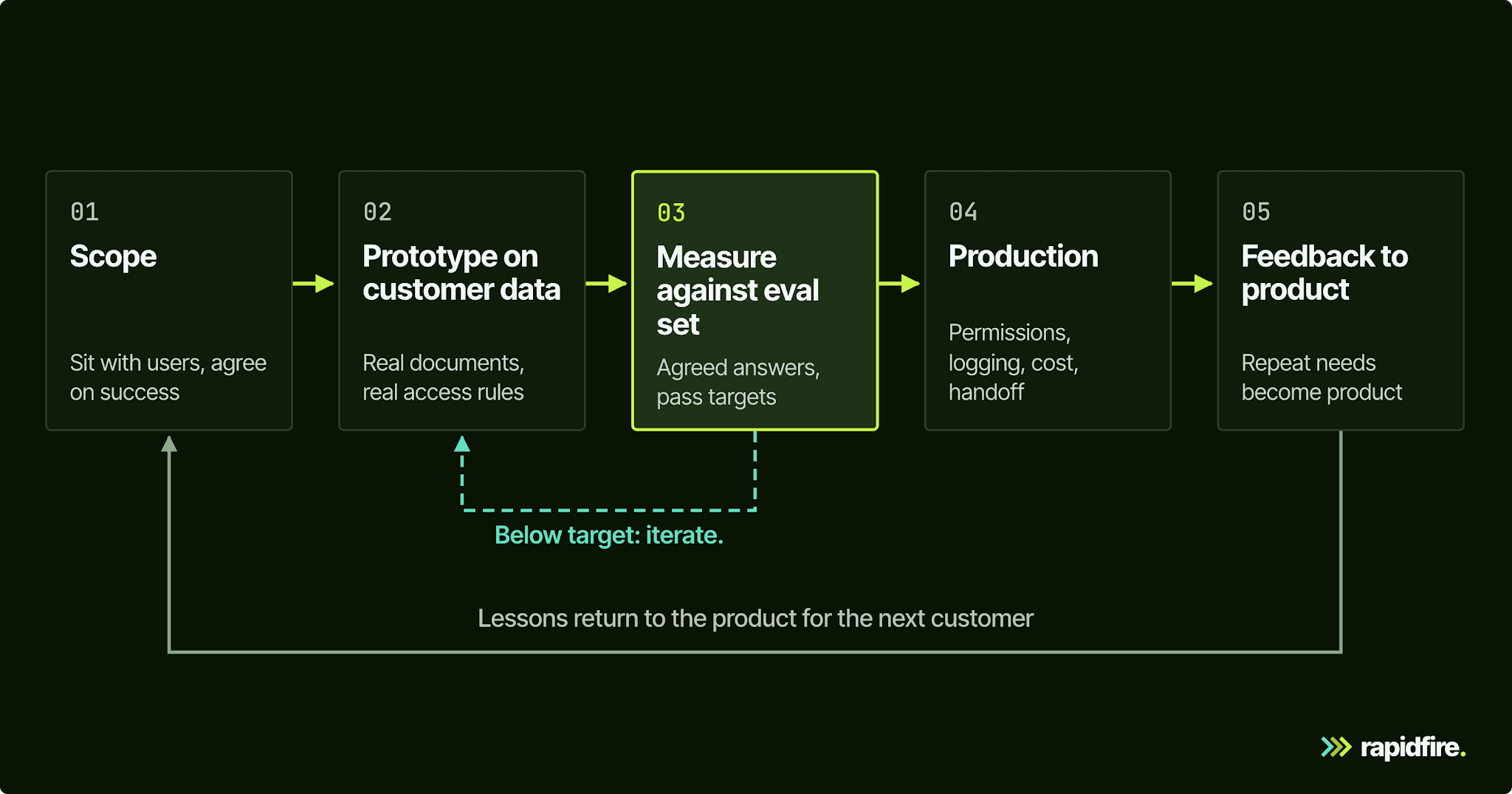
Laid end to end, with measurement pulled out as its own step, the work forms a five-stage loop: Scope, Prototype on customer data, Measure against eval set, Production, and Feedback to product. Separating measurement from implementation makes the release decision explicit.
Forward Deployed Engineer vs. Software Engineer vs. Solutions Engineer vs. AI Engineer
The titles overlap, and plenty of forward deployed engineers come from one of these roles. The cleanest way to separate them is by what each role is measured on.
Role | Primary goal | Who they work with | Writes production code? | Measured on |
|---|---|---|---|---|
Forward deployed engineer | Get the product working in one customer's real environment | Customer engineers, domain experts, the vendor's product team | Yes, in the customer's environment | Production adoption and business outcomes at that customer |
Software engineer | Build features that serve many customers | Product managers, other engineers | Yes, in the core product | Feature quality, reliability, adoption across the user base |
Solutions or sales engineer | Win the deal | Prospects, account executives | Usually demos and proofs of concept | Technical wins and deal progress |
AI engineer | Build and improve LLM or ML systems | Data, product, and platform teams | Yes | Model and system quality on internal evals |
Consultant | Deliver a defined project | Client stakeholders | Sometimes, often custom solutions owned by the client | Project delivery against scope |
The consultant comparison matters most, because it's the one FDEs get lumped in with. In Palantir's model, the existing platform supplies much of the solution; the FDSE adapts and combines its capabilities for the customer rather than starting a separate system from scratch. FDEs still build custom solutions, but the ones that repeat should flow back into the product.
Skills a Forward Deployed Engineer Needs
FDE postings read like two job descriptions stapled together. You need enough technical depth to ship and enough judgment to know what to ship.
Technical Skills
Python fluency and comfort across the stack come first, since you'll touch APIs, data pipelines, and front ends inside systems you didn't design. At AI companies, the bar now includes hands-on LLM work: building RAG pipelines, prompt and context design, agents, and evaluation. Anthropic's FDE role combines production LLM experience with prompt engineering, agent development, and evaluation. Those skills belong together: you can't defend a deployment you can't measure.
Customer-Facing Skills
Turn customer needs into testable requirements, explain trade-offs such as faster answers versus more citations to a non-technical sponsor, and document the system so the customer's team can operate it. OpenAI's FDE role includes communicating with engineers, product teams, and customer stakeholders; that communication helps everyone agree on what to build and how to judge it.
Why AI Companies Are Hiring Forward Deployed Engineers Now
Access to a general-purpose model leaves deployment work to do: connecting customer data, enforcing access rules, integrating workflows, and evaluating outputs. An FDE works with the customer's engineers and domain experts to make those decisions in the environment where the system will run.
Deployment quality also depends on the decisions around the model: how documents get chunked, what gets retrieved, which model and prompt to use, and how to score the result. Those choices depend on the customer's data, so they can't be settled once at the vendor's headquarters.
The incentives line up too. At OpenAI, an FDE's success depends on whether customers adopt the production system, whether their workflows improve measurably, and whether evaluation results inform product and model development. That ties the role to business outcomes rather than shipped features.
How FDEs Get AI Pilots Into Production
A pilot stalls when nobody can show, with numbers, that the system is good enough. Here's the playbook we'd hand any FDE stuck at that point:
Build a small eval set with the customer's experts: real questions, agreed answers, and pass targets per metric.
Change the knobs in order of impact. Data preprocessing and retrieval choices usually move quality most, then models and prompts, then evals and tooling.
Compare many configurations against the same eval set instead of tuning one setup by feel.
Show the customer the evidence, including where the best option still falls short.
Running retrieval and context engineering variants one at a time makes each comparison wait for the preceding run. That's the problem we built RapidFire AI, our open-source experimentation engine, to solve. It launches many RAG, prompt, and fine-tuning configs at once so you can compare them on the same eval data, and it lets you stop weak configs mid-run, then clone and expand the strong ones. For RAG with closed model APIs, you don't need a GPU.
In our work with a global automotive manufacturer, the customer's team had already hand-curated a 28-question eval set and benchmarked two existing stacks. After a handful of days with that team learning the data, we ran a full grid of 432 configurations in two days. The winner ran on the vector database the customer already used and led on 5 of 7 shared Ragas metrics against the stronger existing stack on each. No system, including the winner, cleared every internal pass target. The winner ranked first on Answer Correctness but only about 282nd on Faithfulness. That's the conversation an FDE should be having with a customer: here's the best option we found, here's the trade-off, here's what still needs work.
How to Become a Forward Deployed Engineer
There's no single path in, but the ability to deliver a complex system when requirements are unclear is central to OpenAI's FDE role. For software engineers eyeing the move, build evidence for the role by owning a customer-facing project end to end: take a vague request, scope it, ship it, and measure it.
Pay depends heavily on company and seniority. Two pay-transparency postings, pulled in October 2026, show the spread:
Palantir's New York FDSE role, asking for 1+ years of post-college experience, lists a base salary of $135,000 to $200,000 a year, with total comp that may also include RSUs and a sign-on bonus.
OpenAI's San Francisco FDE role, asking for 5+ years including customer-facing work, lists $185K to $300K plus equity.
Factor in travel when you compare offers: Palantir's posting asks for up to 25%, and OpenAI's up to 50%.
Conclusion
A forward-deployed engineer earns their keep by turning a promising demo into a measured, production-grade system on one customer's own data, and then making the product better for the next customer. Start measurement during scoping: agree on an eval set with the customer's experts, compare options against it, and show the customer the numbers.
If you're running that loop on RAG or context engineering for a customer, you can try RapidFire AI in a Colab notebook and compare configurations on a sample dataset before your next kickoff. For a larger customer deployment, you can also book a technical call with our team.
Forward Deployed Engineer FAQ
What Is a Forward Deployment Engineer?
It's the same role under a different name. "Forward deployment engineer" and "forward deployed software engineer" both describe an engineer embedded with customers who builds and ships the product in their environment.
How Much Do FDEs Get Paid?
Base ranges in the two postings cited above (pulled October 3, 2026) run from $135,000 to $200,000 at Palantir to $185K to $300K plus equity at OpenAI. Expect the numbers to move, so check current postings.
Is a Forward Deployed Engineer a Good Career?
It suits engineers who like variety and seeing their code used immediately, and it builds skills: scoping, customer judgment, and delivery under pressure. The trade-offs are travel, context switching, and a lot of one-off work if your employer doesn't turn field learnings into product.
Is an FDE Just a Consultant With a New Title?
Sometimes, and it's fair to ask. The difference should be ownership and feedback: an FDE writes production code on the vendor's platform, stays accountable for the outcome, and sends what they learn back to the core product. If a role has none of that, it's consulting.