Solutions

Customer Support
Customer support AI must balance four critical dimensions simultaneously: accuracy (grounded in official policies), helpfulness (solving problems empathetically), safety (avoiding liability and bad commitments), and scalability (handling volume consistently). Generic LLMs fail this challenge—they either hallucinate dangerous answers or become rigidly unhelpful. Success requires purpose-built grounding systems that retrieve comprehensively, synthesize without inventing facts, cite sources transparently, and escalate intelligently when needed.




This example shows how to fine-tune a lightweight chat LLM under limited compute, then use outcome-driven experimentation to converge on the best training configuration for support Q&A.
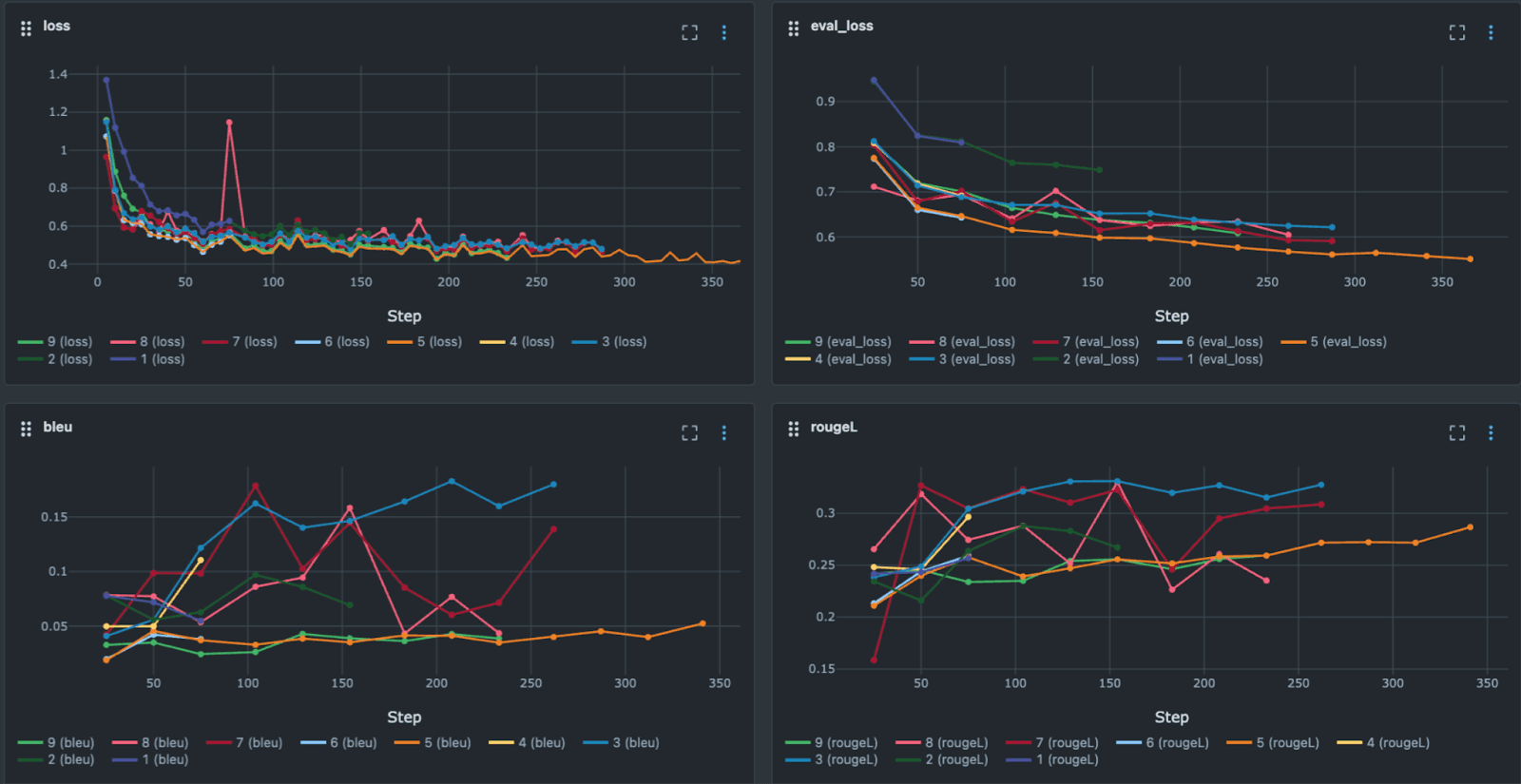
Visualization of training and evaluation loss curves, identifying Run 8 as the optimal configuration for achieving stable convergence and high-quality, on-brand support responses.
What this solution does

Aligns responses to your support knowledge and tone (policies, troubleshooting steps, return rules, etc.)
Produces helpful, natural customer-facing answers that generalize beyond verbatim reference text
Dataset
Bitext customer support instructions + reference responses, subsampled to fit Colab runtime.
Agent
A fine-tuned, chat-oriented model used as a customer support Q&A assistant, optimized for fluent and well-calibrated answers in realistic support scenarios.
Key takeaways
Aligning the training format to how the model naturally “talks” materially improved quality.
Model adaptation worked best when we gave it enough capacity and tuned optimization to converge quickly without instability.
Overlap-style metrics can be misleading for support; we prioritized signals that reflect generalization and real response quality over template-like copying.

How RapidFire AI helped
Compared many fine-tuning configurations side-by-side in one coordinated run.
Tracked results in real time to make faster decisions.
Stopped underperforming directions early to save compute.
Iterated efficiently by cloning the best run and changing one factor at a time to pinpoint what actually drove improvement.

How to apply this to your support data
This workflow is a template for tuning on your own proprietary support content:
Use your ticket history / macros / knowledge base articles as instruction-following pairs.
Sweep a small set of knobs (formatting, LoRA capacity, LR) to converge quickly.
Select winners by loss + human spot checks, not overlap-only metrics like ROUGE.