Solutions

Icon
Icon

Solutions

Icon
Icon

Solutions

Icon
Icon

Scientific Research

Scientific research QA demands high-precision retrieval—missing the one critical passage can break the answer, while keeping hallucinations low and maintaining traceability back to the source paper. This example is a practical reference for optimizing those trade-offs efficiently, and a jumpstart for your own scientific or technical QA application.


Bento Card 01

Bento Card 01

Bento Card 01

Bento Card 02

Bento Card 02

Bento Card 03

Bento Card 03

This example is a practical reference for managing those trade-offs efficiently and a jumpstart for your own implementation:
01

Dataset

QASPER (Question Answering on Scientific Papers) — 1,585 NLP research papers with 5,049 expert-annotated questions.

02

Agent

A retrieval-first RAG workflow designed to identify the single most important supporting chunk (and a short shortlist) from scientific papers, so responses stay factually grounded and contextually relevant.

03

Objectives

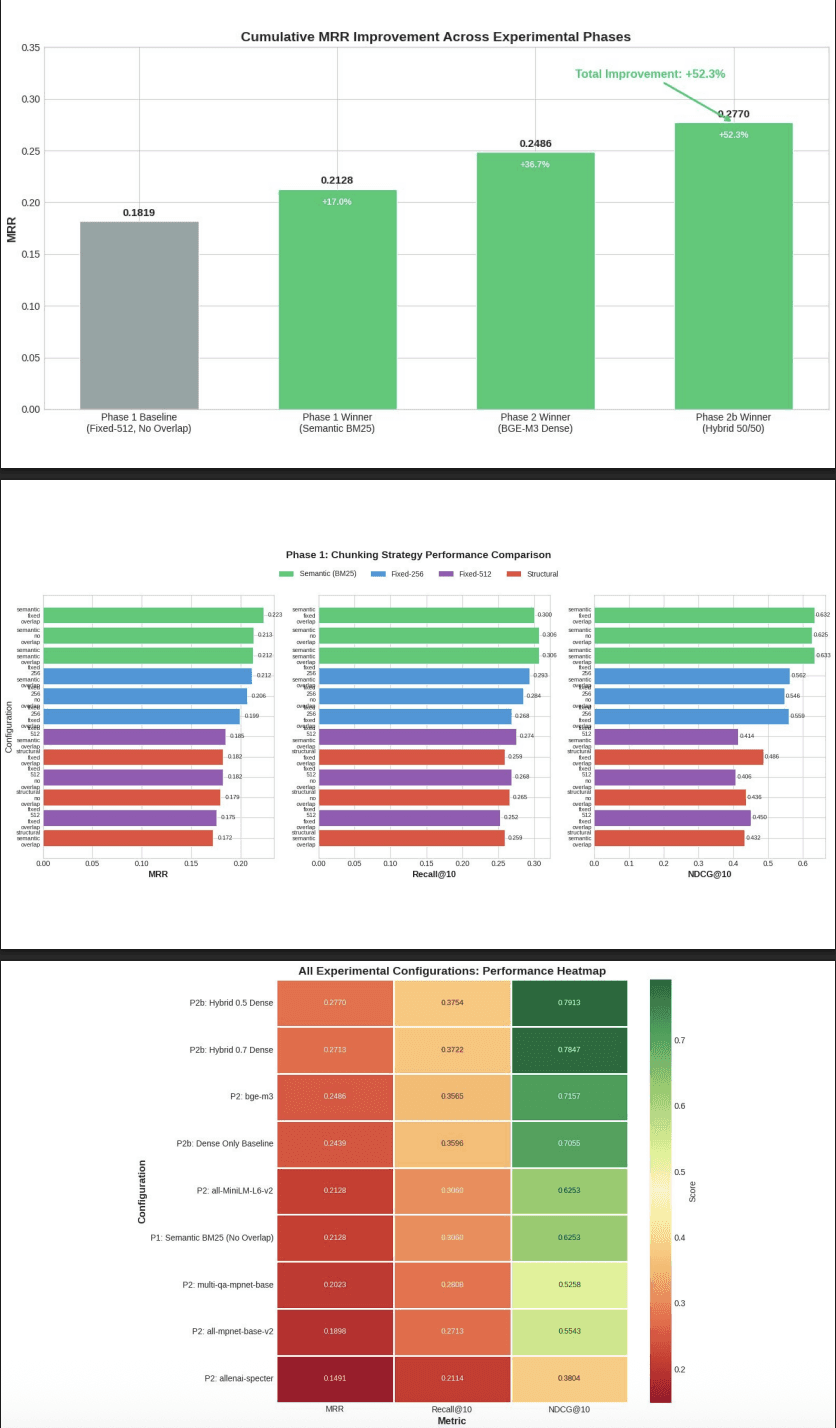
Improve scientific QA by systematically tuning retrieval “knobs” (chunking → embeddings → hybrid retrieval) and tracking Mean Reciprocal Rank (MRR) so the system reliably surfaces the best supporting passage first.

01

Dataset

QASPER (Question Answering on Scientific Papers) — 1,585 NLP research papers with 5,049 expert-annotated questions.

02

Agent

A retrieval-first RAG workflow designed to identify the single most important supporting chunk (and a short shortlist) from scientific papers, so responses stay factually grounded and contextually relevant.

03

Objectives

Improve scientific QA by systematically tuning retrieval “knobs” (chunking → embeddings → hybrid retrieval) and tracking Mean Reciprocal Rank (MRR) so the system reliably surfaces the best supporting passage first.

01

Dataset

QASPER (Question Answering on Scientific Papers) — 1,585 NLP research papers with 5,049 expert-annotated questions.

02

Agent

A retrieval-first RAG workflow designed to identify the single most important supporting chunk (and a short shortlist) from scientific papers, so responses stay factually grounded and contextually relevant.

03

Objectives

Improve scientific QA by systematically tuning retrieval “knobs” (chunking → embeddings → hybrid retrieval) and tracking Mean Reciprocal Rank (MRR) so the system reliably surfaces the best supporting passage first.

How to Apply This to Your Data

This workflow shows how to operationalize Outcome Engineering for proprietary scientific corpora (papers, protocols, lab notes, internal wikis). By testing different chunking, embedding, and retrieval configurations side-by-side—and locking in winners phase-by-phase—you can engineer the retrieval behavior your QA agent needs before you optimize generation.