RAG vs Fine-Tuning: How to Choose (and When to Use Both)
Written By:
Matt Tanner
Published on

If your support assistant is answering from an old policy, that's a different problem from an extraction workflow returning prose where you need JSON. Start with the failure you need to fix, then compare RAG and fine-tuning on answer quality, cost at expected query volume, latency, and deployment constraints.
RAG supplies passages from an external knowledge base at query time, so you can update that knowledge base without changing model weights. Fine-tuning changes weights to improve task behavior, format, or tone. Neither guarantees correctness; test the configuration against the failure you are trying to fix.
Below: how each works, the trade-offs side by side, when to combine them, and how to settle it with a fair test on your own eval set.
RAG vs Fine-Tuning: The Short Answer
RAG changes what the model sees at answer time: it retrieves relevant passages from external data and adds them to the prompt. Fine-tuning changes the model itself by training its weights on examples. Use RAG for knowledge that changes or needs citations. Fine-tune for behavior, output format, and narrow, high-volume tasks.
| RAG | Fine-tuning |
|---|---|---|
What it changes | The context in the prompt | The model weights |
Fixes | Missing, private, or stale knowledge | Wrong behavior, format, or tone |
What you need | Documents and a retriever | Curated input/output examples |
Updating knowledge | Re-index the documents | Retrain the model |
Can show sources | Yes, from the retrieved passages | Not on its own |
Per-query overhead | A retrieval step and a longer prompt | None beyond the model call |
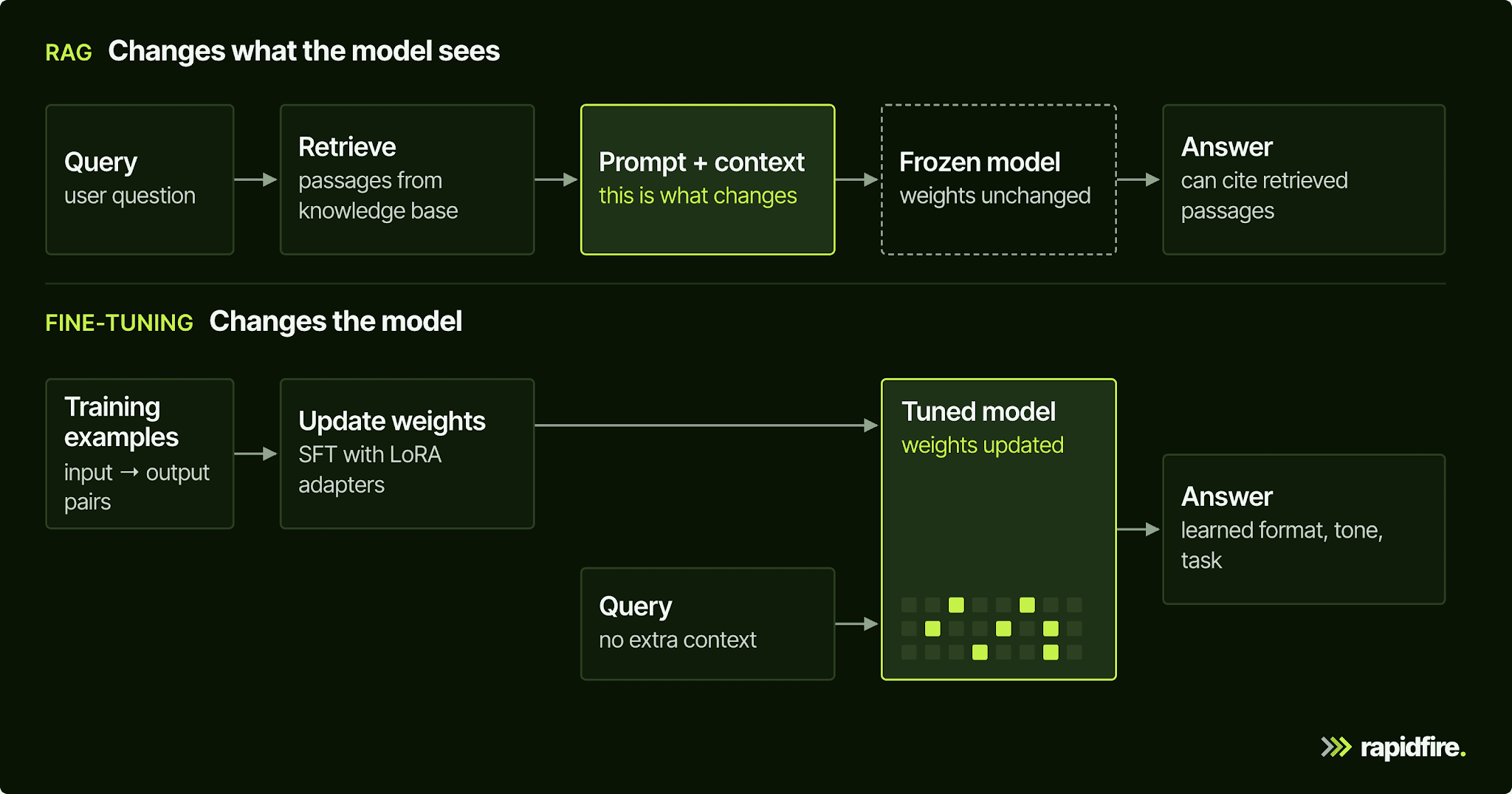
How RAG and Fine-Tuning Work
What Is RAG?
Retrieval-augmented generation (RAG) lets a model look up information before answering. Instead of relying only on what it learned during training, it receives relevant passages from your documents. The 2020 paper by Lewis et al. combined a language model with a searchable document index to address two problems: updating its knowledge and identifying where an answer came from.
A typical RAG system prepares the documents before anyone asks a question. It splits them into chunks and uses an embedding model to turn each chunk into a numerical representation of its meaning. Those representations are stored in a searchable index.
At query time, the system looks for chunks related to the question. A reranker can take a closer look at the candidates and choose the most relevant ones. The selected passages go into the prompt, giving the model evidence to use in its answer.
For a travel-insurance support assistant, that means a policy update can enter the knowledge base without retraining the model. The assistant can retrieve the updated clause and cite it in an answer.
That only helps if retrieval finds the right passage. Chunk size, embedding choice, the number of results retrieved (k), and reranking all affect what evidence reaches the model. Our RAG pipeline guide walks through each stage.
What Is Fine-Tuning?
Fine-tuning teaches a pretrained model how to handle a task by continuing its training on examples. For instance, you might show it customer requests paired with the exact structured output your application needs. The learned behavior is stored in the model's weights, rather than supplied through those examples in every prompt. You still need to test whether the behavior carries over to new inputs.
Full fine-tuning updates every model parameter. Parameter-efficient fine-tuning (PEFT) reduces the training work by updating a smaller set instead. With LoRA, the base weights stay frozen while small additional matrices, called adapters, learn the task. Their rank (r) controls their size.
You can merge those adapters into the base weights for deployment, avoiding extra adapter computation during inference. QLoRA further reduces training memory by keeping the frozen base model in 4-bit form while training adapters. These methods make fine-tuning more accessible, but they don't remove the work of preparing good examples and evaluating the results.
What you train on matters as much as the fine-tuning process itself. SFT, DPO, and GRPO differ in the training signal they learn from:
Method | Trains on | Typical use |
|---|---|---|
Supervised fine-tuning (SFT) | Examples of correct responses | Classification, strict output formats, task behavior |
Direct Preference Optimization (DPO) | Pairs of a better and a worse answer | Tone, style, and preference alignment |
Group Relative Policy Optimization (GRPO) | Rewards on several sampled answers per prompt | Reasoning tasks such as math |
DPO gets preference alignment from a simple classification loss, without the separate reward model and reinforcement learning loop of classic RLHF. GRPO, introduced with the DeepSeekMath model, is a reinforcement learning method that scores each sampled answer against the rest of its group. Hugging Face's TRL library ships trainers for all three, so you don't have to write these training loops yourself.
Updating model knowledge through fine-tuning can be less effective than retrieval. Ovadia et al. found that RAG outperformed unsupervised fine-tuning in their knowledge-injection experiments; the comparison is specific to their models, data, and training setup.
RAG vs Fine-Tuning: Key Differences
Factor | RAG | Fine-tuning |
|---|---|---|
What changes | What the model reads per query | How the model behaves on every query |
Best for | Changing, private, or citable knowledge | Format, tone, classification, narrow tasks |
Data you need | A clean, permissioned document collection | Curated, labeled input/output examples |
Upfront cost | Indexing pipeline and retrieval tuning | Data curation, training runs, GPU time (less with parameter-efficient methods) |
Per-query cost and latency | Retrieval call plus extra context tokens | Lower per call, especially on a small model at volume |
Keeping knowledge current | Re-index changed documents | Retrain, hours to days per cycle |
Citations and traceability | Answers can point to retrieved passages | No built-in link back to a source |
Team skills | Data engineering, search relevance, evals | ML training, data labeling, evals |
Typical failure mode | Wrong or missing chunks retrieved | Confident answers outside its training, stale facts |
A few rows need more than a table cell.
Cost depends on query volume. RAG adds retrieval and context tokens to each request. Fine-tuning adds training costs upfront; a small tuned model may then cost less to serve, provided it stays busy enough to justify the hardware.
Our case study on schema linking shows the trade-off. The fine-tuned 1.5B model cost $419.56 per million queries versus $876 for Gemini 2.5 Flash, but its task score was 0.135 lower. The self-hosted estimate assumed 60% GPU utilization. At low volume, paying for idle capacity can make a small language model (SLM) more expensive than an API.
Those are study estimates, not current price quotes. The study compared fine-tuned open models with prompted closed APIs, rather than RAG. It illustrates a cost-versus-quality decision, not a winner between the two techniques.
Data privacy cuts both ways. RAG keeps sensitive documents out of the weights, but your vector databases still need real access control so each user retrieves only what they're allowed to see. Permission-aware vector stores enforce that boundary at retrieval, an OWASP mitigation for vector and embedding weaknesses. Fine-tuned weights don't carry per-document permissions, so anything in the training set should be visible to every user of that model.
Skills are the hidden cost of fine-tuning: running SFT on a small model needs engineering expertise as well as GPU time. Part of that expertise is searching a large configuration space. In our enterprise tabular-model case study, sequential training limited the team to a few dozen configs across choices such as learning rate, attention heads, and column masking. Sharded parallel execution on the same four GPUs expanded that search past 2,000 configs. RAG needs expertise too, just a different kind: parsing, chunking, and search relevance.
When to Use RAG
Reach for RAG first when the problem is that the model doesn't know something:
Your knowledge changes daily or needs to be near real time, like pricing, policies, inventory, or tickets, so re-indexing new data beats retraining.
Users need citations they can check, which matters in support, legal, and internal compliance answers.
The data is private and access-controlled, and different users should see different documents.
You need question answering over a large body of internal documents that would never fit in a prompt.
You need to ship soon and don't have labeled training data yet.
When Ovadia et al. compared ways to inject knowledge, RAG consistently beat unsupervised fine-tuning, both on knowledge the model had seen before and on entirely new knowledge. The 7B models they tested also struggled to learn new facts through fine-tuning. If facts are the gap, retrieval is the more direct fix.
RAG has limits of its own. It won't make a model follow a format it keeps breaking, and a standard top-k pipeline handles "summarize this whole document" requests poorly, because retrieval hands the model a few chunks rather than the full text. If that's your workload, put the whole document in a long-context prompt, or summarize it in sections and combine the results. Fine-tuning can improve how a model summarizes, but the document still has to reach it.
When to Fine-Tune
Fine-tune when the model knows enough but behaves incorrectly, or when it costs too much to run:
You need a strict output format, such as JSON that matches a schema, and prompting alone keeps breaking it.
Tone and style must be consistent, and prompt instructions keep drifting.
The job is a narrow, domain-specific task like classification or extraction, with clear right answers.
Domain-specific jargon or identifiers trip up the model, and you have labeled examples.
A narrow, high-volume task is running on a large API model, and a small fine-tuned model could do it cheaper and faster.
You want to distill a larger model's behavior into a smaller one for latency or cost.
The schema-linking study gives a concrete example: the model had to identify which database tables and columns a question needed, then return the result as JSON. LoRA SFT on 301 examples raised Qwen2.5-Coder-1.5B's task score from 0.351 to 0.705. Strict JSON validity rose from 40.6% to 100%.
That means the tuned model made better selections and returned usable output more consistently on that eval set. It does not guarantee valid output for every new input. If every response must match a schema, add schema-constrained decoding and validation. Our SLM vs LLM guide covers when a small model is enough.
Running that model is its own decision. If data can't leave your environment or the volume justifies dedicated GPUs, see our guide to self-hosted LLMs. One warning before you fine-tune for facts: Gekhman et al. found that new facts introduced through fine-tuning are learned slowly and, once learned, increase the model's tendency to hallucinate.
When to Use Both (Hybrid Approaches)
RAG and fine-tuning act at different layers and can be combined in three ways:
A fine-tuned generator on top of retrieval. Fine-tune for format and tone, and retrieve for facts. Retrieval-augmented fine-tuning (RAFT) takes this further by training the model on questions paired with retrieved documents, including distractors, so it learns to ignore passages that don't help. It improved results on PubMed, HotpotQA, and Gorilla.
Fine-tuned retrieval components. Leave the generator alone and fine-tune the embedding model or the cross-encoder reranker on your domain, since each task needs its own notion of similarity. See our guide to reranking in RAG.
RAG first, fine-tuning later. Ship with RAG, log where answers fail on format or behavior, and turn those failures into training data. This builds a training set from observed failures: the fine-tuning set comes from real traffic instead of guesses.
Every hybrid means two systems to build, evaluate, and keep in sync. A retrieval change can shift what the fine-tuned model sees, and a retrained model can respond differently to the same context, so re-run the whole eval set after either one changes.
Don't assume the combination always wins, though. A Microsoft study on agricultural data saw accuracy rise by over 6 percentage points from fine-tuning and another 5 from adding RAG on top. But in the Ovadia study, RAG plus fine-tuning did worse than RAG alone on current-events questions. Same idea, different data, opposite results, which is exactly why you test it on yours.
Where Prompt and Context Engineering Fit
Before either, try the cheapest lever: a better prompt and better context. If the model returns prose when you need JSON, show it two examples of the exact output. If it misreads your jargon, define the terms in the system prompt. You can test these prompt changes before committing to training-data preparation and a fine-tuning run. So when people ask "RAG vs fine-tuning vs prompt engineering," sort the options by cost: prompting comes first.
Few-shot examples aren't automatically better, either. In the schema-linking study, several closed models scored best zero-shot, beating their few-shot versions on both quality and cost. Measure it like any other change.
Prompting runs out when the knowledge simply isn't available to the model (that's RAG territory) or when the behavior won't stick across thousands of calls (that's fine-tuning territory). RAG itself is part of the same discipline: choosing what goes into the context window. Our explainers on context engineering and few-shot prompting go deeper.
How to Decide With Evidence: Test Both on Your Own Data
Rules of thumb get you to a shortlist. They don't tell you whether a well-tuned RAG setup clears your bar, or whether a fine-tuned 1.5B model is good enough to replace an API call.
Start from the symptom to decide what to test first:
What you see | Try first | Test next |
|---|---|---|
Wrong, missing, or outdated facts | RAG over the right documents | Retrieval tuning: chunking, k, reranker |
Right facts, wrong format or tone | A prompt with examples | SFT on labeled examples |
Good answers, but too costly at volume | A smaller model with a better prompt | A fine-tuned small model |
Answers need sources or per-user access | RAG with permission-aware retrieval | A fine-tuned reranker or embedder |
Compare the approaches under the same constraints:
Write down the bar first. Name the accuracy target, latency budget, cost per query at expected volume, and deployment constraints (can data leave your network, do you have GPUs). Then build one eval set from real queries with expected answers. Fix the metrics before you pick a technique: answer correctness, faithfulness to retrieved context for RAG, format validity, latency, and cost. Split it into a development set for tuning and a held-out set you don't touch until the end. Our guide to LLM evaluation metrics covers the options.
Give each approach a fair search. RAG has its own knobs: chunking, the embedding model, the retriever, k, the reranker, and the prompt. Start with data preparation and retrieval, since that's where knowledge of your own data pays off. Fine-tuning has its own: base model, training data, LoRA rank, and learning rate. A tuned RAG pipeline against a default fine-tune (or the reverse) measures effort, not technique.
Compare quality and cost per query side by side. Score the best configs from each side on the same held-out set, and put cost and latency next to quality.
Confirm, then revisit. If outputs are sampled at nonzero temperature, rerun before trusting a small gap. Re-check when query volume grows, because serving economics shift with it.
We built RapidFire AI to run this comparison process across configurations. Its two experiment modes cover retrieval and context engineering, and fine-tuning and post-training. Use run_evals() to compare retrieval configurations on one eval set. Use run_fit() to compare training configurations through our Hugging Face TRL integration, including SFT, DPO, and GRPO. You define the choices to test and the metrics that matter to your application.
You can inspect results while experiments are still running. For RAG configurations with supported metrics, RapidFire shows running estimates with confidence intervals as it processes smaller groups of examples, called shards. That helps you decide which weak configurations to stop and which promising ones to explore further.
To enable these estimates, your Python metric functions must declare the supported metric type and value range. Shuffle an eval set that is sorted by topic or difficulty first; otherwise, its early shards may not represent the whole dataset.
Cloning lets you try a variation of an existing run. For fine-tuning, keeping the same model and adapter architecture allows a warm start from the parent's learned weights. Changing the learning rate can use that shortcut; changing the base model or LoRA rank requires a fresh start.
For RAG, clones can vary search settings, the reranker, the generator, and the prompt. Chunking and the document index stay fixed during that run. These limits matter when deciding which configurations belong in the same experiment.
Two of our case studies, run separately, show how much each side moves when it's tuned. They're different tasks with different metrics, and neither compares RAG against fine-tuning.
On the retrieval side, our two-application case study includes an illustrative travel-insurance chatbot. We tested 40 retrieval configurations while keeping the generator and embedder fixed. One retrieve-then-rerank setup used 512-token chunks, retrieved 10 candidates, and reranked them down to 2 passages for the model. Its retrieval composite rose from 0.439 to 0.627, about 43%. The improvement came from changing what evidence reached the model, rather than changing the model itself. The 76 questions were synthesized from the policy, so this was a controlled demonstration, not proof of the same gain on live customer traffic.
On the fine-tuning side, in the schema-linking study, 16 SFT configs (base model, schema format, LoRA rank) were trained concurrently on 2 A100 GPUs in about 3.5 hours, producing the 1.5B result above. Each config was trained once, so we flag in the study that repeated runs are needed to confirm the differences.
Read both as "best on that eval set," not "best in production."
Conclusion
Retrieval-augmented generation changes what the model sees at answer time, and fine-tuning changes how it behaves. Pick based on the problem in front of you, whether that's missing facts, unreliable format, or cost at volume, and try better prompts and context first. Then settle it with a fair test: one eval set, a real search on each side, and quality and cost compared together.
Try both sides hands-on with our Colab notebooks. The RAG notebook on Colab compares four retrieval configs on a financial Q&A dataset and starts in under 2 minutes. The fine-tuning notebook on Colab runs four SFT configs of a small Qwen3 model on customer-support data: two LoRA configurations, each paired with two trainer configurations.
You can also run our open-source package locally with pip install rapidfireai. Setup steps are in the RAG and context engineering quickstart and the fine-tuning and post-training quickstart.
If you're planning this for a production system, or need agent workflows the open-source package doesn't cover, talk to our team.
FAQ
Is There Anything Better Than RAG?
It depends on the job. Small document sets can go straight into a long-context prompt, though language models use information buried in the middle of long contexts less reliably. For format and behavior, fine-tuning is the better tool. For knowledge that changes or needs citations, RAG is still the default, and tuning its retrieval can pay off. In the retrieval case study above, it moved the composite score about 43%.
Is Fine-Tuning Still Worth It?
Fine-tuning can help with formats, tone, and narrow tasks, but check the available training route before building around a provider. OpenAI is winding down its hosted fine-tuning platform, which no longer accepts new users. An alternative is training LoRA adapters on an open-weight model with a library such as TRL.
Is RAG Cheaper Than Fine-Tuning?
Usually upfront, not always per query. RAG skips training but adds retrieval and extra prompt tokens to every call. A fine-tuned small model can be cheaper to run when your GPUs stay busy, but it can cost more than an API at low volume. Model your expected query volume before deciding.
Does Fine-Tuning Reduce Hallucinations?
Not reliably for facts. Fine-tuning on new facts can raise hallucination rates, and grounding answers in retrieved sources is the more direct fix. Fine-tuning does reduce a different failure: malformed or off-format output. In the schema-linking study, it took strict JSON validity from 40.6% to 100%.
Can You Use RAG With a Fine-Tuned Model?
Yes. Fine-tune the model for format, tone, or domain behavior, then retrieve facts at query time. RAFT goes a step further and trains the model on retrieved documents, including distractors, so it learns to use good context and ignore bad context. Test the combination on your data, since it doesn't always beat RAG alone.